
Oak Creek Directory Collections
Oak Creek research works best as a network search. The Oak Creek Public Library local-history collection is the most specific local starting point. Milwaukee Public Library supplies regional directory coverage, while UWM Libraries and the historical societies hold records that can confirm a dated name or address. Some sets are indexed, some require browsing, and some are only available in a reading room.
| Collection | Years | Where Held | Access |
|---|---|---|---|
| Oak Creek Pictorial | February 1956 to November 2006 | Oak Creek Public Library | DVD in library |
| Sceptre yearbooks | Listed years from 1959 to 2018 | Oak Creek Public Library | Quiet Reading Room; DVD through 2014 |
| Oak Creek obituary index | 1956 to 2007 | Oak Creek Public Library | In-library index |
| Milwaukee city and suburban directories | City set from 1847; suburban volumes documented 1998 to 2005 | Milwaukee Public Library | Print, microfiche, and microfilm |
| Milwaukee County deeds | 1835 to 1886 | UWM Libraries, Micro Series 16 | Reference and microfilm |
| Pre-1907 vital index | Early records, mostly 1880 onward | Wisconsin Historical Society | Online index and microfilm |
The table does not imply a complete run. Oak Creek-only directory years and publishers were not found in the official sources reviewed. Milwaukee Public Library documents address browsing in its city directories from 1921 and points researchers toward suburban volumes. Treat those books as regional leads, then verify that the actual entry identifies Oak Creek.
Oak Creek's Local History Shelf
The library's collection is unusually strong for the years just after Oak Creek became a city. The Pictorial can connect a name with a school event, club, street, business, photograph, or civic activity. Its obituary index can supply a second dated lead. Sceptre yearbooks add student names, portraits, teams, and activities, though a school appearance is not proof of a home address.
The displayed yearbook coverage has gaps. Listed print years include 1959 through 1968, 1970 through 1972, 1974, 1976 through 2005, and 2007 through 2018. The DVD covers 1959 through 2014. Do not smooth those ranges into one continuous series. Ask library staff whether a missing volume exists elsewhere.
The DVDs may be viewed on a library computer or a personal laptop, but they do not circulate. A valid Milwaukee County library card is required for public-computer DVD viewing. Record the issue, page, image, or yearbook year for every find.
See the Milwaukee Public Library local-history directory catalog before a regional visit.

The catalog image helps distinguish the long Milwaukee city run from suburban directory leads that must be checked volume by volume for Oak Creek entries.
Note: A library index is a finding aid; request or inspect the underlying item before treating its name, date, or address as confirmed.
Read Oak Creek Directory Entries
A city directory entry is a snapshot created for one publication cycle. Its exact fields depend on the publisher and year. Start by photographing the title page and abbreviation key. Then copy the entry exactly, including initials, spelling, punctuation, symbols, and the printed place name. A short code can change the meaning of the line.
| Name | The listed person or householder, often abbreviated with initials. |
|---|---|
| Spouse or family clue | A name in parentheses or a relationship note, when the volume uses one. |
| Work line | A period occupation or business affiliation, useful only as dated context. |
| Address | The printed house number, street, rural route, or locality for that year. |
| Status mark | A publisher-specific symbol that may distinguish an owner, householder, boarder, or resident. |
| Widow notation | A dated family-history lead that may point toward a death record or obituary. |
Never assign a standard meaning to a mark without checking that volume's key. The research did not locate a single Oak Creek publisher whose symbols apply across the whole collection network.
- Criss-cross directory
- A directory arranged by street and house number instead of only by surname.
- Householder index
- A list keyed to the person associated with a household in that publication.
- Abbreviation key
- The publisher's legend for shortened words and symbols used in that edition.
- Index entry
- A pointer to a source, not always the full source image or certified record.
Oak Creek Historical Directory Network
The Oak Creek Historical Society offers genealogy help and maintains archives tied to the city's local past. The society formed in 1964 to help save the original Town Hall and now preserves a six-building pioneer village. Its role is local and distinct from the county and university archives.
The library holds an Oak Creek Historical Society Archival Resource Index in print and on DVD. Use the index to identify a collection, cemetery, church, organization, person, or place, then ask for the underlying item. The Wisconsin Historical Society affiliate record independently confirms the organization.
Open the Oak Creek Historical Society's public page to see the setting and preservation work behind this archive.
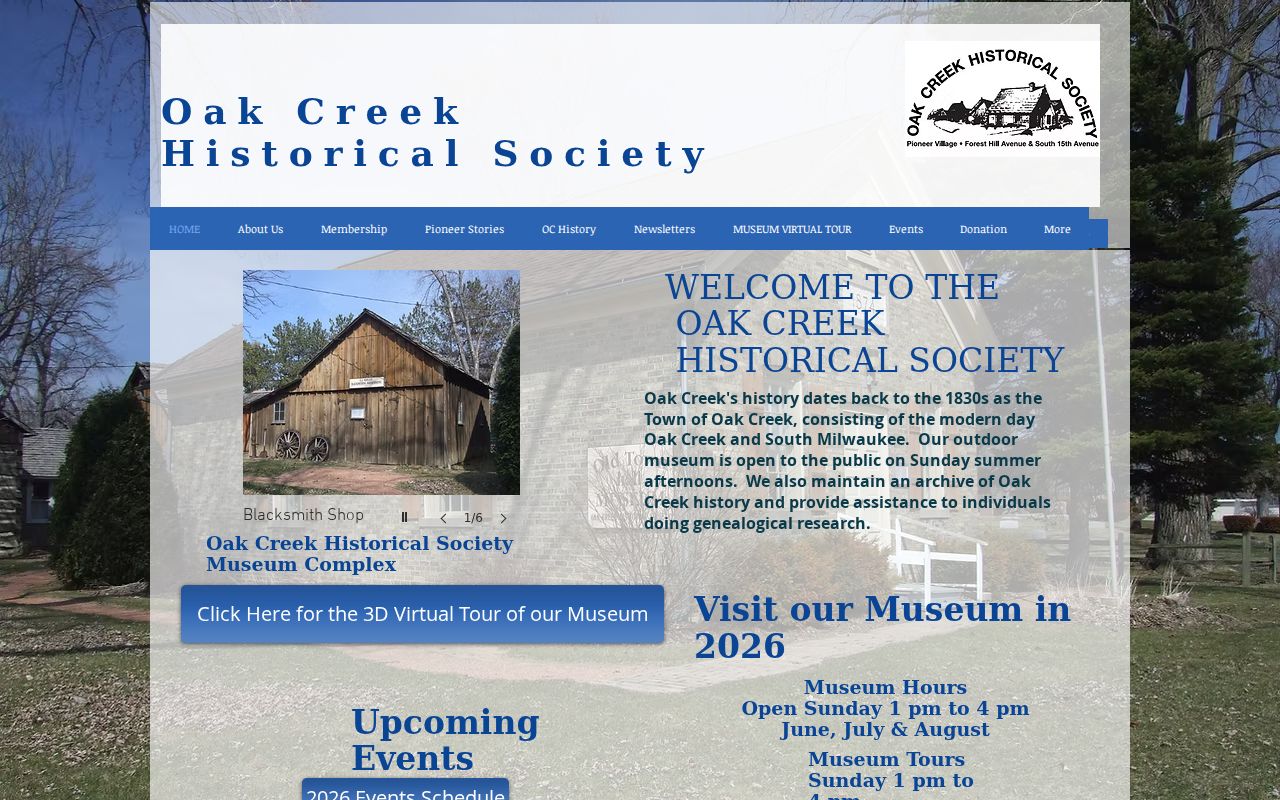
That local collection can explain a name or place that a regional city directory lists only briefly, especially when the entry belongs to the township era.
Oak Creek Records Across Eras
Oak Creek's name changed meaning over time. Period labels help choose the right shelf and prevent a modern city name from being imposed on an older county or township record.
| Date | Record-search consequence |
|---|---|
| 1830s | Settlement-era names may appear in Milwaukee County sources. |
| 1840 | Oak Creek Township becomes the relevant government label. |
| 1852 | County vital registration begins, though early enforcement was weak. |
| 1955 | Oak Creek city status begins on December 15. |
| 1956 | The library's Pictorial creates a local post-incorporation news and photo trail. |
| 1964 | The Historical Society begins organized preservation work. |
For early work, search Oak Creek Township and Milwaukee County as well as Oak Creek. A rural route or county description should remain in the transcript. Later parcel and deed research can link the historic place to a modern address, but it should not rewrite the old source.
Oak Creek Beyond City Directories
The UWM Milwaukee Area Research Center holds Milwaukee County deeds, vital indexes, registers, name changes, and other genealogy sources. The Milwaukee County Historical Society Research Library adds county agency files, probate and naturalization material, manuscripts, and photographs. Holdings are scattered, so ask for an item-level check.
The Wisconsin Historical Society family-history collections include the Wisconsin Name Index, local histories, census sources, professional directories, and obituary scrapbooks. Its name index is not comprehensive. A missing hit should move the search to county microfilm, a local index, and alternate spellings rather than end the inquiry.
This archive network supports a useful handoff: city directory or yearbook to obituary, obituary to vital index, and then index to a custodian-held record. Each step answers a different question.
Trace Oak Creek Family History
Follow one household in small, dated steps. A gap can mean a move, death, omitted listing, changed spelling, or a collection gap. It does not supply the answer by itself.
- Begin with the most certain full name, approximate year, and Oak Creek place label.
- Search a name-arranged volume, then copy the full entry and its abbreviation key.
- Check the address-arranged section when the volume has one, and note other names printed at that address.
- Move one available directory year at a time and log changes in spelling, address, and household notation.
- Pair public census years with the closest directory years, keeping each source's date distinct.
- Test a disappearance in the Oak Creek obituary index, WHS vital index, probate route, or a later regional volume.
Recent decades cannot be filled by a public census because federal census records follow a 72-year release rule. Local newspapers, yearbooks, dated civic sources, and official record indexes are the proper bridge. For a modern name verification after a historical find, use the Oak Creek resident lookup workflow without assuming that the old and current person are the same.
Limits of Oak Creek Directories
A printed listing does not prove who lived at an address on every day of that year. Publication cutoffs, unlisted households, spelling errors, border labels, and missing volumes all create gaps. A city directory can identify a dated association between a name and place, but a parcel record, deed, obituary, yearbook, or vital index may be needed to explain it.
Modern address-keyed land records answer a different question. They concern parcels, taxes, and recorded ownership, not a full list of occupants. The Oak Creek street directory page handles that current address trail. Keep archival research focused on lawful family history, house history, and civic research, and never use a historical listing to intrude on a living person's privacy.
Best practice. Save the repository, collection title, volume year, page, exact entry, and access date so another researcher can repeat the search.