
Oak Creek Previous Resident Sources
Start with the source closest to the date in question. Current land records provide a parcel key, not a household list. Recorded instruments extend the ownership chain much farther back. Directories, census schedules, yearbooks, obituaries, probate files, and local collections add people who may never have held title. Their coverage is uneven, which is part of the evidence.
| Source | Years it covers | Where held | What it shows |
|---|---|---|---|
| Recorded deeds | 1835 to present; search keys vary by era | Milwaukee County Register of Deeds | Recorded parties, transfer date, legal description, document or book/page |
| Milwaukee County deed microfilm | 1835 to 1886 | UWM Libraries, Milwaukee Micro Series 16 | Grantor and grantee addresses, consideration, land description, and recording data |
| Milwaukee and suburban directories | Milwaukee run 1847 to present; address browsing from 1921; suburban volumes documented 1998 to 2005 | Milwaukee Public Library and CountyCat | Dated name and address leads, subject to volume coverage |
| Oak Creek Pictorial | February 1956 to November 2006 | Oak Creek Public Library DVD | Names, streets, businesses, schools, civic events, and organizations by issue |
| Oak Creek obituary index | 1956 to 2007 | Oak Creek Public Library | A dated lead to a death notice and family network |
| Sceptre yearbooks | Listed years from 1959 to 2018, with gaps | Oak Creek Public Library | School ties and a dated local appearance |
| Federal census schedules | Public releases through 1950 | NARA and library genealogy resources | Households, ages, relationships, and location for a census date |
An Oak Creek previous residents search usually starts with the city parcel record for a modern address. It then moves through deeds until the record age or changed place label calls for a library or archive. No complete Oak Creek-only city directory run or official Sanborn coverage was located, so those sources should never be promised as if they exist for every year.
Reverse Milwaukee County Deed Chains
The chain of title is the recorded sequence of ownership transfers. Begin with the owner and legal description shown in Oak Creek Land Records, but do not assume that the tax mailing address is the property address. The legal description and parcel number are the bridge when a street label changes.
- Search the Oak Creek Land Records workflow. Set municipality to Oak Creek, record the current owner as displayed, and copy the parcel key and legal description.
- Find that party's purchase instrument through the Register of Deeds real-estate search. Capture the document number, recording date, grantor, grantee, and land description.
- Search the seller, or grantor, as a grantee in an earlier period. Compare the legal description before accepting the match.
- Repeat the switch from grantor to earlier grantee. When names fail, follow any referenced prior document, book/page citation, tract, or plat key.
- Change access mode as the date recedes. Use historical appointments, book and page, or UWM deed microfilm instead of forcing a modern party-name search.
Broad online keys cover recordings from 1962 forward. Deeds from April 1, 1948 forward have grantor, grantee, tract, or document-number access. For 1835 through March 31, 1948, the county generally requires a document number or book and page. Plats from 1835 through June 1991 use document, plat-book, or page keys, while broader access begins in July 1991.
- Grantor and grantee
- The grantor transfers an interest; the grantee receives it.
- Chain of title
- The linked sequence of recorded transfers for the same land.
- Legal description
- The formal description that identifies land even when the street address changes.
- Recording date
- The date an instrument entered the public record, which may differ from its signing date.
Oak Creek Previous Resident Deeds
Tapestry is a paid search and image-access route for occasional users, while Laredo is aimed at regular professional access. Search modes can include party, tract, and document keys. A name result is only an index lead until the legal description and prior instrument align with the same Oak Creek parcel.
The successful manifest capture shows the official Tapestry grantor-grantee interface.
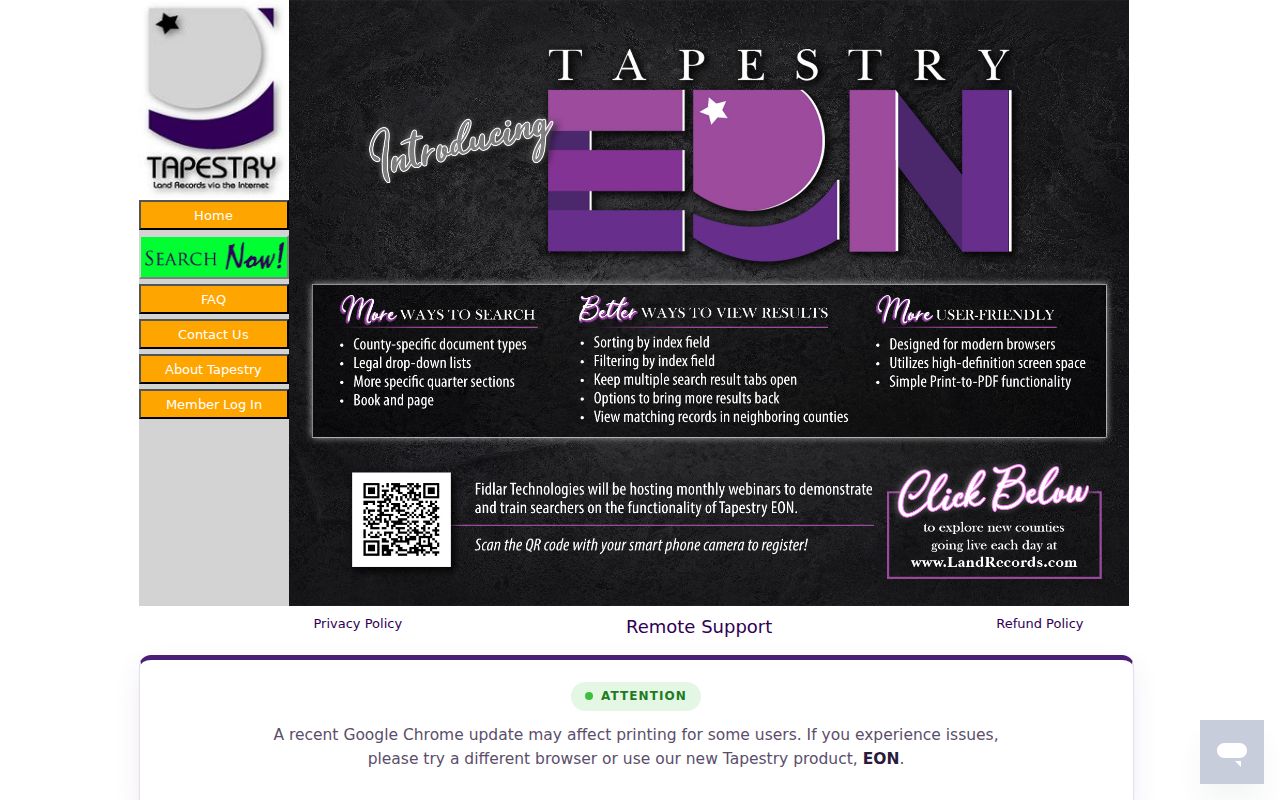
The search-mode choices make a key point: historical deed work changes keys as it goes back. Record the result metadata even when an image is not purchased. County copies cost $2 for the first page and $1 for each added page, with $1 added for certification. Tapestry session and image charges are separate and should be checked before use.
Note: A deed proves a recorded land transaction, not every person who lived at the address during that owner's tenure.
Oak Creek Resident History Timeline
Historical Oak Creek begins before the modern city. Settlement dates to the 1830s, Oak Creek Township was organized in 1840, and incorporation took effect December 15, 1955. Search old instruments and local records under Oak Creek, Oak Creek Township, Milwaukee County, and any rural-route form actually printed in the source. Do not silently rewrite a township-era place as a city address.
An 1845 Wisconsin Historical Society item records an Oak Creek petition tied to a pier and an incorporation-related civic request. It supplies a locality clue, not a household census. In 1964, the Oak Creek Historical Society formed to save the original Town Hall and later developed a six-building pioneer village. Those milestones show how civic records and preserved local sources arose at different times.
A full annexation history, verified local renumbering table, and Oak Creek Sanborn map run were not located. Mark those as gaps. Milwaukee Public Library's 1930 Milwaukee address converter can teach a method, but it must not be applied to an Oak Creek address without local evidence.
Oak Creek Resident History Archive
The Oak Creek Public Library local-history collection is the main local fallback when a deed identifies land but not the people around it. Search the Pictorial DVD by street, business, school event, civic group, or organization, then note the issue date, page, and image. The obituary index can extend a name into family links, while Sceptre yearbooks document school ties in listed years.
The library also holds the Oak Creek Historical Society Archival Resource Index in its second-floor Quiet Reading Room. It can point from a cemetery, church, collection, or place name to the underlying item. The index is a finding aid, not the record itself. DVD collections are for in-library use and do not check out. A valid Milwaukee County library card is required for public-computer DVD viewing.
The local-history screenshot failed in capture, so no library image is displayed. That does not remove the access route. Researchers can use a personal laptop where allowed, ask library staff about the index, contact the Historical Society for genealogy help, or follow a regional lead to Milwaukee County Historical Society, UWM Libraries, and the Wisconsin Historical Society.
Pair Oak Creek Directory Years
Past residents who never owned a parcel may still appear in a dated directory or census. Keep the deed chain and household trail in parallel columns rather than blending them. Milwaukee Public Library documents address browsing from 1921 and suburban volumes for 1998 through 2005, but no complete Oak Creek-only run was found. The collection details belong on the Oak Creek Directory Book page.
- Choose a deed date or known event and look for the nearest directory year that includes the Oak Creek area.
- Search the printed address exactly, then test the historical township, county, or rural-route label shown by an older record.
- Compare the listing with the nearest public federal census schedule. Preserve the census date, enumeration place, household order, and spelling.
- Use the next available directory year to see whether the name remained, changed, or disappeared. Treat each result as a dated snapshot.
- Check the obituary index, probate route, yearbooks, and Pictorial for a plausible endpoint or family connection, then cite the underlying item.
A criss-cross directory is arranged by address rather than only by surname. An enumeration district is the small area assigned to a census taker. Both can help when a person's name is misspelled, but neither proves continuous residence between publication dates.
Close Oak Creek Resident Trails
Obituaries, probate, cemetery sources, and vital indexes often provide the final dated link for previous residents. The Oak Creek obituary index covers 1956 through 2007, but the underlying notice must still be found and cited. Milwaukee County Probate Court keeps estate and guardianship files reaching into the 1830s. Pre-1985 probate material generally requires in-person access; later cases may begin with WCCA, while copies come from the court custodian.
Vital research changes at October 1907. Wisconsin DHS manages later state records and controlled genealogy access. Earlier work uses the Wisconsin Historical Society index, county material, and repositories such as UWM. Early county registration began in 1852 but was weak before about 1880, so failure to find a pre-1907 event does not prove it never happened.
For a deceased owner, probate may identify heirs or an estate representative, while a deed records the resulting land transfer. Keep the probate case, certificate, obituary, and deed as distinct evidence. Access rules and relationship requirements still apply to certified vital copies.
Oak Creek Previous Resident Deed Eras
The county's changing search keys explain many failed previous residents searches. The official real-estate records coverage page is the control source for those eras.
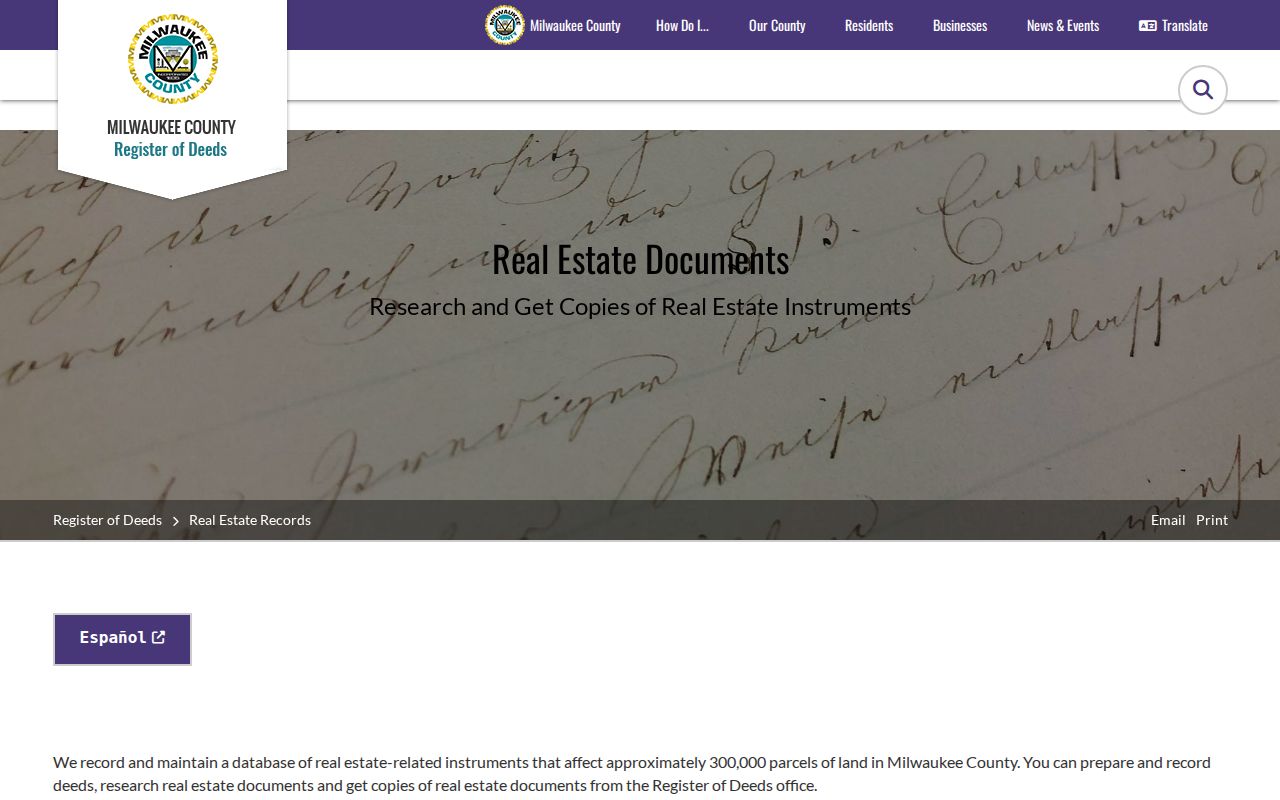
The capture shows the county route for historical coverage, copies, and appointments. If a party search ends before the target deed, switch to the document number or book/page found in the newer instrument. UWM's Milwaukee Micro Series 16 then supplies a reference path for deeds from 1835 through 1886. This is a change in method, not a break in the land's history.
Limits on Oak Creek Past Residents
Ownership and residence are not synonyms. A tax account may show an entity or an out-of-town mailing address. A directory may list a householder but omit other people. A census describes one official date. An obituary can name relatives or a former home, and Safe at Home may suppress an actual address for safety. Absence from any one source is not proof that a person was never there.
Use the narrowest supported statement: a deed named a recorded party, a directory linked a name and address in a stated year, or a census listed a household on its enumeration date. For family history and house history, that precision is more useful than a broad claim about who lived here before.
Lawful use. Research Oak Creek previous residents for genealogy, estate work, house history, or personal curiosity. Never use address findings to track, threaten, harass, or harm a living person.